
The Moa were a group of large, flightless birds native to New Zealand, belonging to the order Dinornithiformes. They were herbivorous browsers that filled the ecological niche of large land mammals, which were absent in New Zealand. Some species grew taller than three meters when stretching their necks, making them among the tallest birds to have ever lived - teara.govt.nz 

PlateXXIII from Extinct Monsters (1896). MOA-BIRDS.
Dinornis giganteus. D. elephantopus.
Height 12 feet. A smaller species. - source 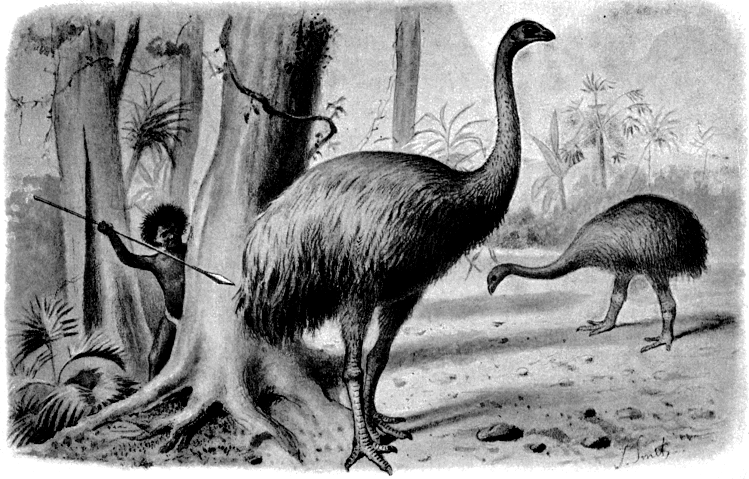
The plate above comes from the chapter Giant Birds from the populat 1896 book Extinct Monsters. The chapter begins with the text: > Of all the monsters that ever lived on the face of the earth, the giant birds were perhaps the most grotesque. An emu or a cassowary of the present day looks sufficiently strange by the side of ordinary birds; but “running birds” much larger than these flourished not so very long ago in New Zealand and Madagascar, and must at one time have inhabited areas now sunk below the ocean waves.
Below we have a quick animation, of the Upland Moa derived from an illustration from a later book Extinct Birds (1907).
HTML5 mp4 http://extinct.fab.fish/assets/pg40000-h/ai/upland-moa.mp4 Upland moa
One of the confusing aspects of Moa study is the number of different named species and genera. Early researchers often described new species from fragmentary remains, leading to overlapping names and classifications. Later analysis showed that many of these so-called species were actually different sexes or age classes of the same bird.
This reclassification reduced dozens of names down to around nine recognized species across several genera, including Dinornis, Emeus, Anomalopteryx, and Pachyornis - britannica.com
The largest species, Dinornis robustus and Dinornis novaezelandiae, were once thought to represent entirely different types of birds, but are now understood as male and female forms of the same genus.
Sexual dimorphism was extreme in moa, with females sometimes twice the size of males. This has contributed significantly to the confusion in naming and classification, making the moa a classic case study in Paleontology about the challenges of reconstructing extinct life - nzgeo.com
# See - Giant Birds from Extinct Monsters (1896) - Upland Moa (Megalapteryx huttoni) - Haast's Eagle - Dinornis ingens - Predation of the Moa